The Prisoner’s Dilemma received a solution to the first part by reader Jesse Waite from Ft. Leavenworth, Kansas. Jesse realized that there are eight vertices in a cube, so that it’s necessary to find eight sums of three of the numbers equaling zero. In addition, each number is used exactly twice in the eight sums (once for each end of the edge). That led Jesse to create the table in figure 2 showing a very nice pattern of three entries in each row and two in each column, so that the sums across are all zero.
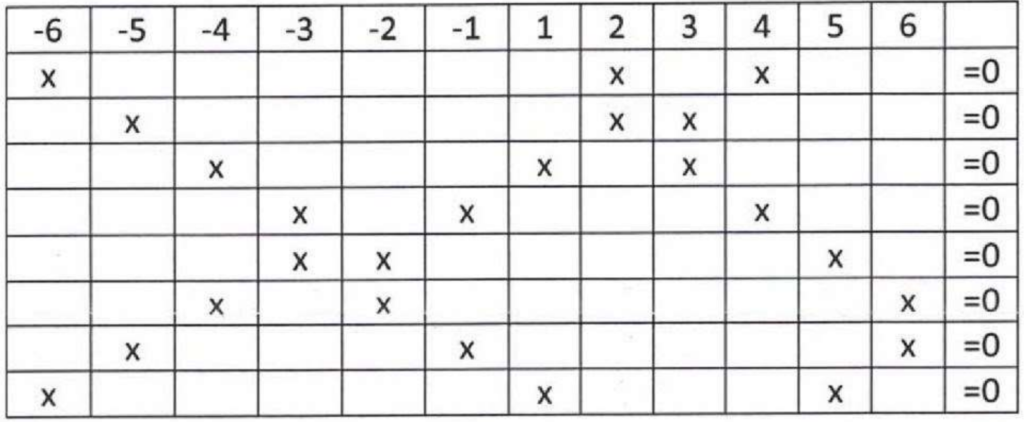
Armed with this pattern, Jesse was able to fit the numbers onto the edges of the cube as shown in figure 3, solving the problem.

For the other part of the problem, recall that the three numbers at each vertex add up to zero. So if you add up all of the sums at all of the vertices, you still get zero. But as Jesse pointed out, adding up all of the sums adds up each number twice. So whatever numbers are used for the edges, twice the sum of all of them has to be zero. And that means the sum of all of them has to be zero. But the sum of the twelve consecutive integers from -5 to 6 is not zero, it is 6. Therefore, the task in the second half of the problem is impossible. ■