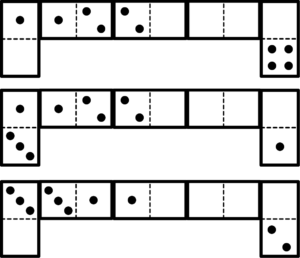
Anthony Batiste and the Georgia Southern University problem group solved this dilemma. One can generate the solutions by assigning variables to each of the squares in turn from left to right, noting that every touching pair must be equal, and then finding integer solutions where the two required totals are equal to five. That analysis has quite a few cases, so we won’t give it in detail here, because Ian has already provided the information that there are exactly three other solutions. Therefore, it suffices to simply show the solutions, which we do in Figure 11.