The Prisoner’s Dilemma received submissions from three PMP participants: a full one from Christopher West, a nearly complete solution from Blazej Kot, and one from Andrew Trentacoste II. The Eagle Problem Solvers of Georgia Southern University also submitted a very thorough solution.
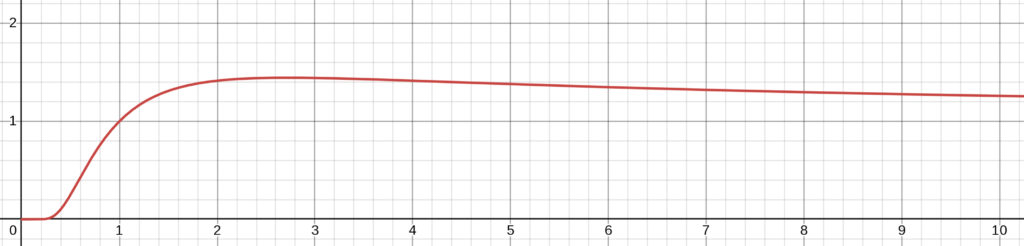
Every complete solution received relied on methods of calculus, so we follow such an approach here. Raising both sides of the equation defining the experbola to the power, we see that it is also the curve satisfying . So determining points on the experbola (and properties of the curve as asked about here) becomes entirely about finding distinct values of for which the function (shown in Figure 6) takes on the same value. In other words, we want to find horizontal lines which intersect the graph of twice. Now, if , then , and so . Therefore, any such horizontal line must satisfy . Relating this observation back to the experbola, all points on it must satisfy and . Moreover, it appears from the graph in Figure 6 that is strictly increasing up to some value of , and strictly decreasing thereafter. Presuming so, it means that any horizontal line can intersect the graph of at most twice, once to the left of that maximum value, and once to its right.
We verify this property by considering the first derivative
Since is always positive, this derivative is positive (i.e., is increasing) when , or in other words, for . Similarly, is strictly decreasing for , and has a unique maximum at . Translating these facts back to the experbola, if is any point on the experbola, one of or is less than and the other is larger.
So for question (a), we already know that in any integer solution, both and must be larger than one, and one or the other must be less than , or in other words, equal to 2. Thus the only integer solutions are , and , .
As the original proposer William Keehn points out, it is easiest to next consider part (d): one can verify by direct computation that for all ,
lies on the experbola. So the desired functions are and .
Turning back to question (b), we want to find asymptotes of the experbola, so we let tend to infinity in and It is easier to work with and Using L’Hôpital’s rule, the limits of and as goes to infinity are the limits of and , respectively. So tends to 0 and to infinity, or in other words, tends to 1 and tends to infinity. Thus, the experbola has a vertical asymptote at , and by symmetry, a horizontal asymptote at
Finally, we can find the point that should be added to restore the continuity of the experbola by taking the limit in the parametrization of the experbola as goes to 1. Using L’Hôpital’s rule again in exactly the same way, we see that both and and approach 1 as tends to 1, which in turn means that and approach , so the “missing” point is .