The Prisoner’s Dilemma received solutions from PMP participants William Keehn and Robert Noll; we follow primarily the former. First show that the minimum number of moves to solve the usual Tower of Hanoi puzzle with discs is by breaking the problem into shifting the top discs (using moves), followed by moving the th disc, followed by shifting the smaller discs back on top of it (using another moves). You can then solve the resulting recurrence relation .
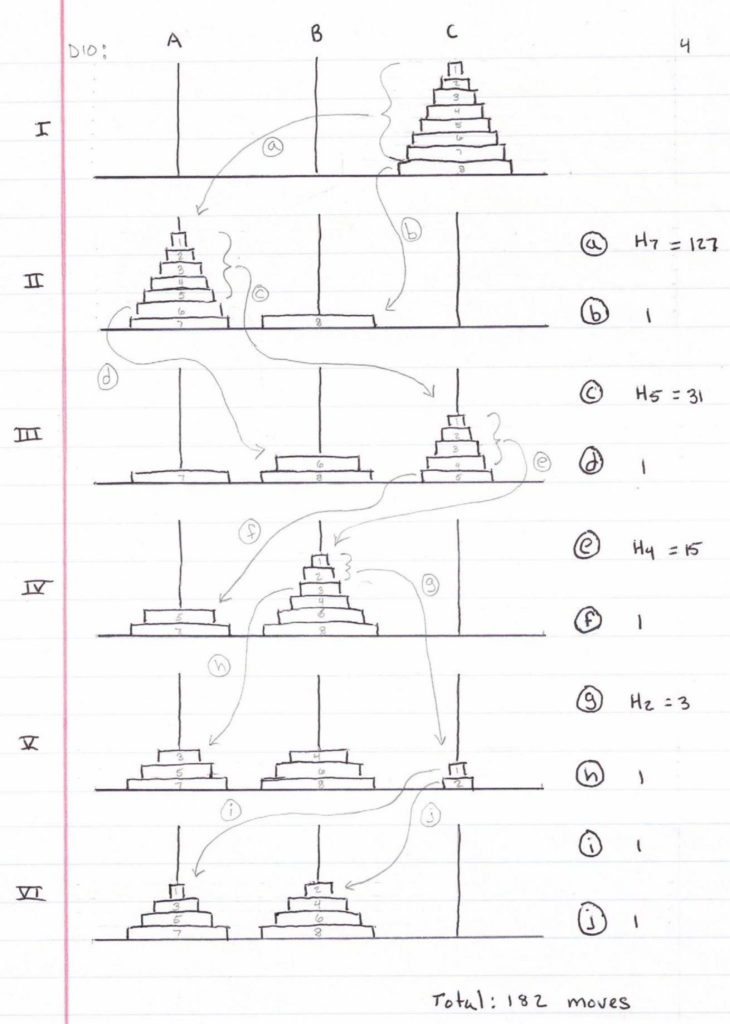
Now consider the problem Prof. Hinz poses. Note that every move is reversible, so if you were to play a film of the optimal solution backward, it would necessarily be the optimal way to turn a pile of eight discs into the configuration shown in Figure 1. But to accomplish this task, you must first use moves to shift the top discs, one move of disc 8, moves to uncover disc 6, one move to put 6 on top of 8, moves to uncover disc 5 and one more to put it on 7, moves to uncover disc 3 and one more to put it on disc 5, and two final moves to put disc 1 on 3 and disc 2 on 4. (This sequence of events is beautifully depicted in William’s drawing shown in Figure 2.) Using the formula for , these phases total 182 moves, the minimum possible.