For convenience, since segment is divided into four equal parts, we introduce coordinates scaled so that . We place the origin at the center of the (semi)ellipse, which is to say the midpoint between the foci and . Thus the equation of the ellipse will have the standard form for some constants and giving the positive – and -intercepts of the ellipse. We’ve included this coordinate system in Figure 2.
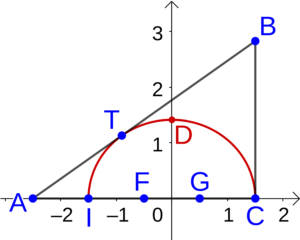
The coordinates of some of the points are immediate:Since is the -intercept of the ellipse, we have . We also added the -intercept in Figure 2. Since , we have by the definition of an ellipse that also , from which we solve for .
Now suppose the coordinates of point are . Then the equation of line is Substituting this value for into the equation of the ellipse to solve for the -coordinate of point (since the equations of both the line and the ellipse must be satisfied at point ), we get
We can write out the rightmost square and multiply both sides by to obtain the quadraticHowever, it is given in the problem that the line is tangent to the semiellipse, so they only intersect in one point. Therefore this quadratic must have only one real root. But by the quadratic formula for , namely , there are two roots unless . In other words, it must be the case thatAgain multiplying out, this equation simplifies to , amazingly enough. Armed with this information, it is easy to compute that so .